

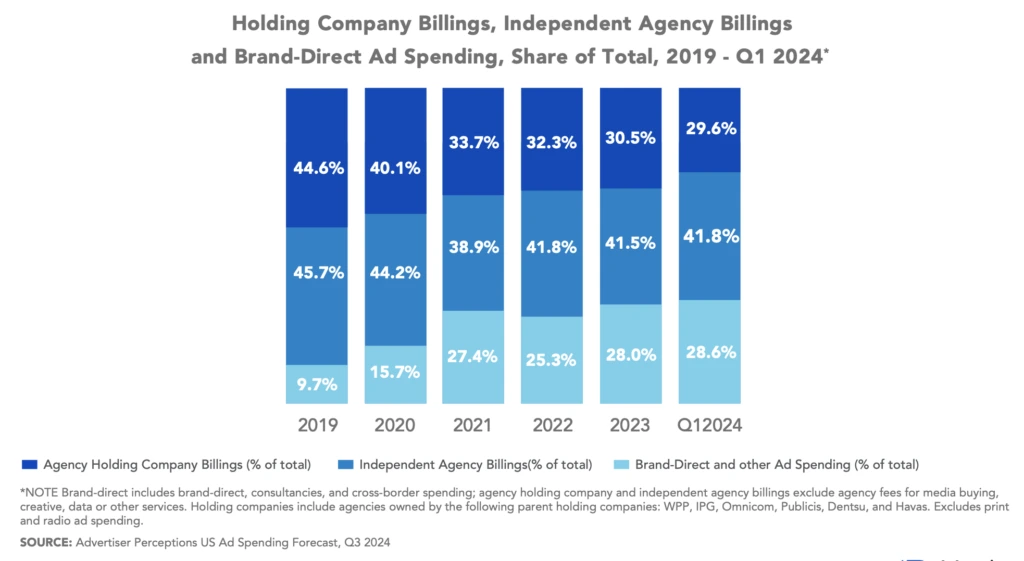

Why B2B Tech Brands Are Choosing Independent Agencies Over Holding Companies
Enterprise software companies are defecting to independent agencies for brand work at rates that seemed impossible five years ago. Vertical fluency beats scale.
The enterprise software company had $200 million in ARR and a brand problem. Their product roadmap was solid. Their go-to-market motion was working. But their brand identity looked like every other SaaS company: sans-serif wordmark, gradient blue-to-purple palette, abstract geometric shapes suggesting "innovation." The CMO called three agencies. Two were holding company shops with "technology practices." One was a 19-person independent in Brooklyn. The indie got the work.
This is happening everywhere. B2B tech brands (the ones with the budgets, the growth targets, the IPO timelines) are defecting to independent agencies at a rate that would have seemed impossible five years ago. Not for performance marketing or growth hacking, but for brand strategy and visual identity. For the work that used to be the exclusive domain of the big brand consultancies and their seven-figure retainers.
The numbers tell one part of the story. Search volume for clusters around "B2B branding agencies," "SaaS branding independent," and "tech startup branding agency" sits at zero in our keyword tracking: not because no one is searching, but because the language hasn't standardized yet. The behavior is ahead of the search terms. Enterprise tech brands aren't Googling "blockchain brand design agency." They're asking their networks: who did that rebrand for Plaid? Who's behind the Notion identity? Who made Figma look like Figma?
The answers increasingly point to shops under 50 people.
The Generalist Tax
The holding company model was built for scale. Account teams that could service Fortune 500 clients across categories. Creative departments that could pivot from CPG to automotive to financial services. The promise: plug into our network and access best-in-class talent across every discipline and every vertical.
For B2B tech brands, that promise broke down in a specific way. The "technology practice" at a holding company shop turned out to be three people who'd worked on Microsoft once, bolted onto a 400-person agency built to serve Coca-Cola. The deck looked impressive. The case studies were real. But the actual team assigned to the blockchain infrastructure company was the same team that had just come off a quick-service restaurant pitch.
Independence changed the equation. A 25-person agency could staff 100 percent of its talent on tech clients. Everyone in the building spoke the language. Everyone understood the difference between B2B SaaS and B2C fintech. Everyone knew why developer experience mattered to enterprise sales cycles. The generalist tax disappeared.
The creative output followed. B2B tech branding stopped looking like "business branding" and started looking like the most interesting work in advertising. The independents working on it weren't trying to make enterprise software feel approachable to midwest CMOs. They were making it feel exciting to the people who actually used it: developers, data scientists, security engineers, product managers. The audience was sophisticated. The branding could be too.
Vertical Fluency vs. Account Structures
The traditional agency account structure assumes rotation. Junior people cycle through brands to build range. Senior people rotate to stay fresh. Account planning sits separate from creative sits separate from strategy. Everyone has their swim lane. The client gets "the best thinking" from across the organization.
This breaks completely for complex technical products. An identity system for a zero-knowledge proof protocol isn't a branding problem you can parachute into. The difference between layer-1 and layer-2 blockchain infrastructure matters to the positioning. The nuance between on-premise enterprise software and cloud-native SaaS matters to the visual language. A generalist team produces generalist work.
Independent agencies solved this with vertical dedication. Not a "tech practice" that gets 30 percent of the shop's attention. Full vertical commitment. When a cybersecurity startup briefs an indie that works exclusively in B2B tech, the strategy director has seen 15 other cybersecurity brands. The design team knows what's cliché in the category. The copywriter understands the regulatory environment. The learning curve is zero.
The holding company counter: we have more resources. The independent reality: all of our resources are pointed at your problem. A 30-person shop where everyone works on SaaS brands has more effective firepower than a 500-person agency where your account gets three people and borrowed time from seven others.
The client vote is clear. Enterprise software companies are choosing deep over broad. Fluency over scale.
The Complexity Translation Problem
B2B tech brands face a branding challenge that doesn't exist in consumer categories. The product is genuinely complex. The value proposition requires technical understanding. The buyer persona includes people with computer science degrees evaluating architectural decisions. And somehow the brand needs to work across that entire spectrum: technical enough to earn credibility with engineers, clear enough to win over the C-suite, differentiated enough to stand out in a category where everyone claims to be "the leading platform for enterprise-grade solutions."
The holding company approach: simplify. Find the emotional core. Strip away the technical language. Make it accessible. The result: every B2B SaaS brand sounds the same. "Empower your team." "Accelerate innovation." "Transform the way you work." Generic value propositions floating above generic product descriptions.
Independent agencies working in this space took a different approach. They translated complexity instead of simplifying it away. They found the brand truth inside the technical differentiation. A database company's brand strategy couldn't ignore that they'd fundamentally rearchitected how distributed systems handle consistency. A dev tools company's visual identity had to acknowledge that their users were people who cared about code elegance.
This required a different kind of strategic thinking. Not "what's the emotional benefit?" but "what's the belief system that makes this technical approach matter?" Not "how do we make this simple?" but "how do we make this complexity feel like an advantage?"
The best work in this space doesn't dumb down the technology. It makes the technology the brand. Stripe's documentation-as-marketing. Figma's interface-as-identity. Notion's flexibility-as-philosophy. These aren't brands that happen to have technical products. These are technical products where the brand and the product are the same thing.
Independent agencies got this because they had to. Their survival depended on actually understanding the clients they served. They couldn't fake fluency. They couldn't hand off the technical brief to a junior strategist and hope for the best. The work required deep engagement with the product, the category, the technology itself. The agencies that built that muscle won the work. The ones that didn't stayed in consumer.
The Speed-to-Market Advantage
Enterprise software brands operate on a different timeline than consumer brands. A CPG company can run the same brand platform for five years. A B2B tech company might pivot its entire positioning twice in 18 months because the market moved or a competitor launched or the product roadmap shifted or the regulatory environment changed or the buyer persona evolved.
Holding company processes weren't built for this velocity. The kickoff takes six weeks. The research phase takes eight. Strategy development takes another six. Creative exploration takes four. Refinement and production take twelve. By the time the rebrand launches, the market has moved. The positioning is stale. The visual identity addresses a problem that's no longer the priority.
Independent agencies compressed the timeline not by cutting quality but by cutting bureaucracy. The team that briefs is the team that strategizes is the team that creates. No handoffs between offices. No routing decks through five layers of approval. No waiting for the holding company's brand consulting arm to bless the strategy before creative can start.
The result: timelines measured in weeks, not quarters. A blockchain infrastructure company needs to rebrand ahead of their mainnet launch in 90 days? An independent can do that. A SaaS company acquired two competitors and needs a unified brand strategy before the integration announcement in six weeks? An independent can move that fast.
This speed advantage compounds. Faster execution means more iterations. More iterations means better work. Better work means stronger results. Stronger results mean the client comes back for the next project. The relationship deepens. The indie becomes the de facto brand partner. The holding company loses the account and writes a blog post about "agility" to explain what happened.
The Category Creation Challenge
The most interesting branding problems in B2B tech aren't happening in established categories. They're happening in spaces that didn't exist five years ago. Zero-knowledge proofs. Edge computing. Headless commerce. Data observability. MLOps. These aren't markets where you position against clear competitors. These are markets where you have to create the category itself.
Category creation requires a different branding approach. You're not differentiating within a known space. You're defining what the space is. The brand work has to educate while it persuades. It has to establish the problem before it can position the solution. It has to create the language that the entire category will eventually use.
This is exceptionally difficult work. It requires understanding the technology deeply enough to articulate why it matters. It requires enough market fluency to know which pain points will resonate. It requires creative courage to make bold claims about a future that doesn't exist yet. And it requires speed: because if you're creating a category, you need to move before someone else defines it first.
Independent agencies have won an outsized share of this work. Not because holding companies can't do category creation. But because the holding company process is too slow and too risk-averse for category creation work. By the time the research is done and the strategy is approved and the creative is refined, the window has closed. Some other company has claimed the territory.
Indies move faster and bet bigger. A 20-person agency can put its entire strategic team on a category creation project for three months. They can take creative risks that a holding company would never approve. They can move at the speed of the market instead of the speed of the approval chain. The work that results often defines not just the client's brand but the entire category's vocabulary.
What the Data Isn't Showing Yet
Search volume for B2B tech branding terms sits at zero in the standard keyword clusters. Not because the work isn't happening. Because the search behavior hasn't caught up to the market reality. Enterprise tech brands aren't searching for agencies the way consumer brands do. They're getting referrals. They're seeing work. They're asking who did that.
This creates an interesting distortion in the market data. If you measure independent agencies by search visibility, you'd miss the entire B2B tech surge. The best work in this space isn't ranking for "blockchain branding agency" because no one is searching that term. The deals are happening through networks. The growth is invisible to traditional agency scorecards.
But the signals are everywhere. Look at the portfolios of the top-performing independents. B2B tech work is overrepresented. Look at the new business announcements in the trades. Enterprise software brands are choosing shops under 100 people. Look at the Cannes Lions and D&AD awards. B2B tech categories now get the same creative firepower that used to go exclusively to consumer.
The market shift is real. The data will catch up. Eventually search terms will stabilize. Keyword clusters will form. Volume will appear. By then the independents that moved early will have locked in relationships that last years. The holding companies will launch new "technology branding practices" and wonder why they can't win the work.
The Ownership Question
Independence matters more in B2B tech branding than almost anywhere else in the agency landscape. The work requires long-term relationships. A consumer brand might hire an agency for a campaign and move on. A B2B tech brand needs a partner that will grow with them: from seed stage to Series B to IPO to market leader. That continuity matters. The agency that understands the product in year one is exponentially more valuable in year three.
Holding company ownership structures break this continuity. The shop gets acquired. The founders leave. The team that won the work gets reassigned. The client gets handed to the holding company's "enterprise technology group" and suddenly they're working with people who've never seen the product. The institutional knowledge evaporates.
Independent agencies offer continuity by design. The team that pitches is the team that delivers is the team that's still there three years later. The founders are involved. The culture stays intact. The client relationship deepens instead of resetting every time the parent company reorganizes.
This matters enormously to enterprise tech brands building for the long term. They're not buying a project. They're buying a partnership. They want the agency that understands their technology roadmap, their competitive landscape, their buyer evolution, their category positioning. They want the people, not the process.
Independence guarantees the people stay.
The Work That's Coming
The B2B tech branding surge at independent agencies isn't a moment. It's a structural shift. As software continues eating the world, the number of B2B tech brands that need sophisticated branding work will only grow. As categories continue fragmenting, the need for vertical expertise will only intensify. As markets continue accelerating, the advantage of speed and continuity will only compound.
The independents that moved early into this space have built unfair advantages. They have the portfolios. They have the referral networks. They have the teams that actually understand how to brand a machine learning infrastructure company or a supply chain visibility platform or a privacy-preserving data collaboration protocol. The holding companies can hire their way into the space, but they can't buy the years of vertical focus that made these independents dangerous.
The next wave of B2B tech branding will be even more specialized. Not just "tech" but "developer tools" or "security infrastructure" or "vertical SaaS for healthcare." The independents will continue fragmenting into tighter and tighter niches. The holding companies will continue trying to build horizontal practices that can serve everyone. The clients will continue choosing depth over breadth.
The market is voting. The enterprise software brands with the biggest budgets and the highest growth rates are defecting to independent agencies. Not because indies operate with fewer resources. Because they're better at this specific kind of work. The technical fluency, the vertical dedication, the speed, the continuity: these aren't nice-to-haves. These are the requirements for branding complex technology in fast-moving markets.
And independence is the only structure that can deliver all of them at once.
Free Agency Media Editorial
All newsYou might like
Gaming Agencies Thrive in a Category That Doesn't Exist on Google
Why AI and Web3 Companies Choose Independent Agencies Over Holding Companies
Why AI and Web3 Companies Choose Independent Agencies Over Holding Companies

The Zero-Search Advantage: Why Independents Win Before the Market Knows to Look
The Case Study Arms Race: Why Independents Win Through Radical Transparency